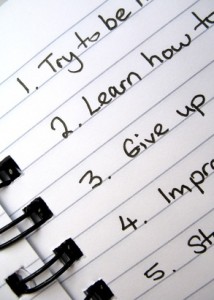
- Writing your goals down improves success rates
I’ve got my work cut out for me tomorrow. See, I have to lift more than I’ve ever lifted on two lifts (weightlifting) by tomorrow to meet my goals.
Maybe you don’t lift weights. Regardless, this article should help you see why written goals are invaluable.
Over the summer, I set weight goals for 7 specific weight training lifts: squats, deadlifts, chinups, barbell rows, dips, bench press, and overhead/military press. The Big 7.
And tomorrow, I’ve got to make good on my self promises.
Goals = Self Promises
That’s a good way to look at goals – they are promises you make to yourself.
In this case, I never told anyone I was going to set personal records.
But I did write them down.
6 Reasons To Always Write Down Your Goals
I know a few weeks ago I said that goals didn’t HAVE to be written down. I simply mean that a goal is a goal, even if not written. But they SHOULD be written down. Here’s why:
- The act of connecting pen to paper, or fingertips to keyboard, in and of itself reinforces the goal.
- You can’t cheat later – the written goal is the metric by which you judge success.
- You can easily refer to the written/printout goal; even daily or multiple times a day.
- Writing lets you work and rework the wording of the goal; word choice matters. For example, one tidbit I love from Tom Venuto: you want to burn fat, not lose weight. Losing weight means you might lose muscle too. And even losing fat isn’t quite right, because if you lose your keys, what do you actually hope will happen? That you’ll FIND them again! Do you really want to find your fat again? No! You want to burn it so that it is gone forever. Small word choices make a huge impact on your success and the best way to get the right words is to right them.
- By writing your goals down, you get the additional positive reinforcement of putting a check mark next to them when you achieve them. For some of us (yes, that’s me) there is a bliss that comes from checking something off your list that makes it even more compelling to complete the goal.
- The physicality of the written paper allows you to force reminders – you can’t escape the list taped to your computer, or on your car steering wheel, or wherever you post them to remind yourself.
So Do I Follow What I Preach?
For each lift, I set two goals: one by the end of August, the other by the end of the year. The exact amounts aren’t important for this article, but keep in mind that I’m not a powerlifter – my lifting is more about physique than about being the biggest and strongest guy (see my site, http://worldiftnessnetwork.com for more info).
I wrote them down, with specific deadlines and with specific amounts. So they were objectively measurable.
I read them at least once a week through July and August.
I met all my August goals.
And I promptly patted myself on the back (yay me!), and then… the goal list…
got lost in my shuffle of papers.
For September, October, and November, I neither thought about nor looked at my list.
Until three weeks ago, when I found the list in the back of my workout log.
I have to admit, when I saw the list, I was not happy at all.
Those goals looked scary.
I didn’t WANT to meet those goals anymore. I didn’t want to lift that much weight. It was so much more comfortable to just keep on my current lifting routine (which I was making progress on – in fact, I actually had set new personal records in all the lifts, just not high enough to reach the numbers I had targeted – what, was I on crack at the time I set those???)
Usually, you’ll hear me talk about how important it is to review your written goals regularly. While that’s a subject for it’s own article, the basic idea is that the more important the goal, and the closer the deadline, the more you need to look at your piece of paper. Some people even tape copies of their most important goals to their toilet seat so that they must read them every day!
In this case, I have to be honest – these weren’t that important of goals to me. My life, and the lives of those I care about, really aren’t impacted by how much weight I can lift. Plus, last summer it seemed like the end of the year was a long way away…
So, I really hadn’t looked at these goals for a while.
I took a deep breath and reminded myself that this is one of the reasons we write goals rather than just stating them.
The written word is far more permanent and doesn’t allow your mind to forget or alter the original goals.
If I hadn’t written them down, there’s no way I would have met my August targets. Back then, the targets were fresh, urgent, exciting, achievable, and written. I easily met them all.
But now (three weeks ago) I was faced with a daunting task of having about 23 days to crush my records in 7 lifts.
I took out my lifting logs to assess the challenge.
Sometimes We Are Closer To Our Goals Than We Think
Turns out I had already met one of the amounts (deadlift). Whew. That left just 6 to go.
I was really close on 2 more. I ended up breaking those the next workout (bench press and chinups).
But the remaining 4 lifts were going to be hard.
So what do you do when your goal level is far from your current level? You set intermediate goals (or action steps).
One of these lifts was the squat. For those of you unfamiliar with lifting, this is where you load up a barbell with weight, hold it across your back, and bend your knees and hips until your hips go lower than your knees, and rise up again.
I needed to add 20 pounds to that lift. So I immediately changed my routines to lifting heavier, for fewer reps, and more rest. Then at the end of those workouts I did extra sets of what are called :partial reps” with super heavy weight. This is where you don’t use the full range of motion, allowing you to get used to much higher weight. Then, before attempting the maximum lift, I made sure the muscles involved were rested at least 4 days.
Using this approach, I met my goals for squats and dips.
But as of this writing, I have not met my goals for barbell rows and overhead press.
And not to make excuses, but I hurt my wrist about a month ago that makes barbell rows very painful. This is a case where visualization is going to make a huge difference. Again, a topic for another article, but when you have to perform, visualization is critical. In this case, I need to prepare not only for the maximum lift but also to ignore the pain.
My training is done – now I need to perform. Tomorrow is the day.
I’ll update this post in the comments section with the results!
I’ve got my work cut out for me tomorrow. See, I have to lift more than I’ve ever lifted on two lifts
(weightlifting) by tomorrow to meet my goals.
Over the summer, I set weight goals for 7 specific weight training lifts: squats, deadlifts, chinups, barbell
rows, dips, bench press, and overhead/military press. The Big 7.
And tomorrow, I’ve got to make good on my self promises.
Goals = Self Promises
That’s a good way to look at goals – they are promises you make to yourself.
In this case, I never told anyone I was going to set personal records.
But I did write them down.
6 Reasons To Always Write Down Your Goals
I know a few weeks ago I said that goals didn’t HAVE to be written down. I simply mean that a goal is a goal, even
if not written. But they SHOULD be written down. Here’s why:
1) The act of connecting pen to paper, or fingertips to keyboard, in and of itself reinforces the goal.
2) You can’t cheat later – the written goal is the metric by which you judge success.
3) You can easily refer to the written/printout goal; even daily or multiple times a day.
4) Writing lets you work and rework the wording of the goal; word choice matters. For example, one tidbit I love
from Tom Venuto: you want to burn fat, not lose weight. Losing weight means you might lose muscle too. And even
losing fat isn’t quite right, because if you lose your keys, what do you actually hope will happen? That you’ll
FIND them again! Do you really want to find your fat again? No! You want to burn it so that it is gone forever.
Small word choices make a huge impact on your success and the best way to get the right words is to right them.
5) By writing your goals down, you get the additional positive reinforcement of putting a check mark next to them
when you achieve them. For some of us (yes, that’s me) there is a bliss that comes from checking something off
your list that makes it even more compelling to complete the goal.
6) The physicality of the written paper allows you to force reminders – you can’t escape the list taped to your
computer, or on your car steering wheel, or wherever you post them to remind yourself.
So Do I Follow What I Preach?
For each lift, I set two goals: one by the end of August, the other by the end of the year. The exact amounts
aren’t important for this article, but keep in mind that I’m not a powerlifter – my lifting is more about physique
than about being the biggest and strongest guy (see my site, http://worldiftnessnetwork.com for more info).
I wrote them down, with specific deadlines and with specific amounts. So they were objectively measureable.
I read them at least once a week through July and August.
I met all my August goals.
And I promptly patted myself on the back (yay me!), and then… the goal list…
got lost in my shuffle of papers.
For September, October, and November, I neither thought about nor looked at my list.
Until three weeks ago, when I found the list in the back of my workout log.
I have to admit, when I saw the list, I was not happy at all.
Those goals looked scary.
I didn’t WANT to meet those goals anymore. I didn’t want to lift that much weight. It was so much more
comfortable to just keep on my current lifting routine (which I was making progress on – in fact, I actually had
set new personal records in all the lifts, just not high enough to reach the numbers I had targeted – what, was I
on crack at the time I set those???)
Usually, you’ll hear me talk about how important it is to review your written goals regularly. While that’s a
subject for it’s own article, the basic idea is that the more important the goal, and the closer the deadline, the
more you need to look at your piece of paper. Some people even tape copies of their most important goals to their
toilet seat so that they must read them every day!
In this case, I have to be honest – these weren’t that important of goals to me. My life, and the lives of those I
care about, really aren’t impacted by how much weight I can lift. Plus, last summer it seemed like the end of the
year was a long way away…
So, I really hadn’t looked at these goals for a while.
I took a deep breath and reminded myself that this is one of the reasons we write goals rather than just stating
them.
The written word is far more permanent and doesn’t allow your mind to forget or alter the original goals.
If I hadn’t written them down, there’s no way I would have met my August targets. Back then, the targets were
fresh, urgent, exciting, achievable, and written. I easily met them all.
But now (three weeks ago) I was faced with a daunting task of having about 23 days to crush my records in 7 lifts.
I took out my lifting logs to assess the challenge.
Sometimes We Are Closer To Our Goals Than We Think
Turns out I had already met one of the amounts (deadlift). Whew. That left just 6 to go.
I was really close on 2 more. I ended up breaking those the next workout (bench press and chinups).
But the remaining 4 lifts were going to be hard.
So what do you do when your goal level is far from your current level? You set intermediate goals (or action
steps).
One of these lifts was the squat. For those of you unfamiliar with lifting, this is where you load up a barbell
with weight, hold it across your back, and bend your knees and hips until your hips go lower than your knees, and
rise up again.
I needed to add 20 pounds to that lift. So I immediately moved my routines to lifting heavier, for fewer reps, and
more rest. Then at the end of those workouts I did extra sets of what are called :partial reps” with super heavy
weight. This is where you don’t use the full range of motion, allowing you to get used to much higher weight.
Then, before attempting the maximum lift, I made sure the muscles involved were rested at least 4 days.
Using this approach, I met my goals for squats and dips.
But as of this writing, I have not met my goals for barbell rows and overhead press.
And not to make excuses, but I hurt my wrist about a month ago that makes barbell rows very painful. This is a
case where visualization is going to make a huge difference. Again, a topic for another article, but when you have
to perform, visualization is critical. In this case, I need to prepare not only for the maximum lift but also to
ignore the pain.
My training is done – now I need to perform. Tomorrow is the day.
I’ll update this post in the comments section with the results!